

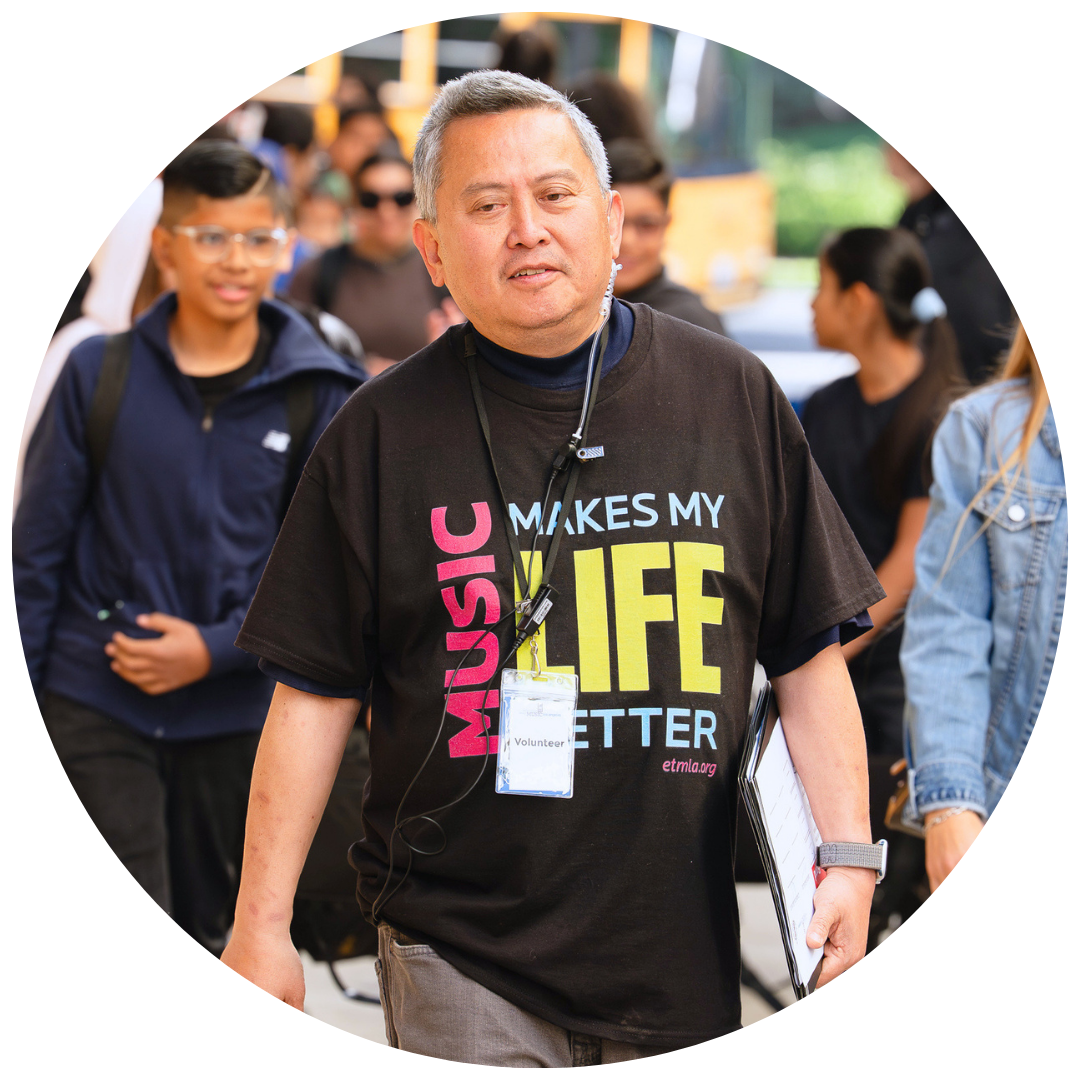
Spotlight on Noel, ETM-LA Volunteer
“ETM-LA’s commitment to communities with limited resources is a mission that runs parallel to my own motivations and goals…”
Spotlight on Noel, ETM-LA Volunteer
Why do you volunteer for ETM-LA?
In the year of 2019, I was going through a mid-life crisis. I decided to enroll in a Child Development Certificate Program with West Los Angeles College. The idea was to study psychology while preparing to work as a Preschool Teacher’s Assistant. I was confident that even if I wasn’t ready to work with children, I could easily land a job as a custodian at an elementary school. It was during my studies that I was introduced to ETM-LA. I was a musician in my earlier years but had gone on an indefinite hiatus. Everyone who knows me knows that I’m very passionate about choir performance and hope to one day become a children’s choir director. I started the Child Development Certificate Program in January 2020, but the COVID-19 Pandemic created complications with the in-person instruction and internship, and everything was moved online. Around this time, I signed up to be included on ETM-LA’s email list. When lockdown ended in 2023, I saw an ETM-LA email invite for a music teacher workshop that was open to anyone interested. I attended the workshop at Dolores Mission School. Since then, I have become a recurring volunteer with ETM-LA.
Can you share a favorite memory while volunteering with ETM-LA?
I have many fond memories of the various ways I’ve supported ETM-LA, but the undisputed champion of favorite memories is the 16th Music Unites the World Festival (which is endearingly referred to as MUWF), and the Teacher/Faculty Choir Performance. 2026, for me, has essentially turned into an ETM-LA volunteer marathon. I volunteered for ETM-LA’s 2026 Winter Academy, 20th Annual Benefit Gala, 16th Annual Principals Leadership Conference, and now the 16th Music Unites the World Festival. On Day 1 of the festival, it had been a long day and I was physically exhausted (this was my first time volunteering at the festival, so everything I did was new, improvised, and on unrehearsed instinct). As the culminating concert neared the finale, I went into the hall and watched the Faculty/Teacher Choir Performance from the house stage left in the back. The children were so excited they could hardly contain themselves. The faculty and teachers sang to the delight of the children. Their onstage passion cannot be described in words. As someone who has more experience listening to adults sing as opposed to listening to children sing, I was humbled by the faculty and teachers as they would sway back and forth singing the words with such genuine conviction, that it left me silently wiping tears from my eyes. If I had access to a golden buzzer, they would have won my endorsement. The children were laser focused on every syllable, note, and beat. And when it ended there was thunderous applause. The children understood the moment even at such a young age. This lesson of music appreciation, nevermind theory-based musicianship, has been planted as a core memory that will live on for this next generation.
How has music and arts education impacted your life?
My mother held a PhD in Pathology and was an avid horticulturist with a glorious garden at our family home. She would show me how to nurture her garden when she was still with us. She was also a classical pianist. Our family consisted of 7 children. We spent our early childhood in the small town of Inwood, West Virginia before moving to Los Angeles in the early 80s. My mother paid a lot of money for our lessons with Mr. Willis, our piano teacher. When we moved, my father built a room specially made for a grand piano, for both myself and my brothers and sisters to practice piano on. This was long before weighted 88-key digital keyboard and noise cancelling headphones and piano audio library samples existed. To learn the piano then, you needed an acoustic piano and a neighborhood isolated enough so neighbors wouldn’t have to unwillingly listen to a child practice for hours on end. I was a mediocre student at best. My siblings were very indifferent to my mother’s wishes for us to play piano. But as the oldest boy in the family, I did my best to practice. Not necessarily because of any inherent desire to be a virtuoso pianist, but rather to please my mother. And I regret nothing. That was a long time ago. Between those early childhood days and now a lot has evolved, but the impact of music in my life is permanent.
Why do you believe in ETM-LA’s mission – providing music as a comprehensive subject as part of the core curriculum for every student in under-resourced schools?
Music isn’t just a form of intelligence, but also a tool. Like a hammer is to a carpenter, music is to an educator. The benefit of making music a comprehensive subject as part of the core curriculum, from my perspective, revolves around using music as a tool for teaching children socialization concepts such as boundaries, sharing, listening, waiting for your turn, cooperation, and collaboration. These skills can be learned during a math or reading class, but that can be especially difficult because the understanding of these two subjects vary from child to child. These skills could also be learned in a physical education class, but that can also be difficult for two reasons: the physical nature of physical education, and what I call the “zero-sum” game nature of physical education. When children are running around, their attention is mainly focused on gross motor skills, and they need space to perform these functions. With music, fine motor skills are moreso the focus and the classroom is more contained. Physical education tends to divide students into groups to compete against one another in a zero-sum game manner. Music is not a zero-sum game activity. Music is a collaborative activity that focuses on helping all participants cooperate with one another in a harmonious way. I witness these concepts during demonstrations and workshops among ETM-LA teachers, and in action when the music teachers directly interact with their students. I am currently finishing a long overdue undergraduate degree in Human Development, and I have future plans for graduate school to further expand my understanding of the ETM-LA mission and vision, or additionally to enter into Law School so I can lobby on behalf of music education advocates. I see how invaluable music and these resources are to the communities ETM-LA reaches. ETM-LA’s commitment to communities with limited resources is a mission that runs parallel to my own motivations and goals of applying to graduate school and re-entering the workforce.